Friday, December 15, 2006

the dimension of line: rosemarie castoro

[outside curve ii, 1976, mixed media, 5” x 14” x 6”]

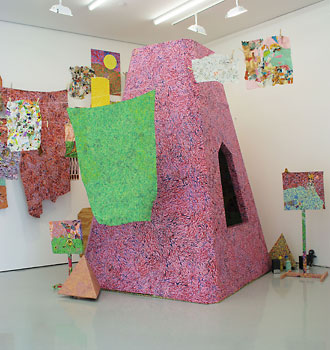
“the dimension of line”—an exhibition of works by rosemarie castoro—spans four decades of endeavor. included are two- and three-dimensional works created from various media. whether rendered in steel, paper, wire, gesso, marble, dust, graphite, or hair, castoro’s work deals with concepts of line, volume, and spatial relationship perception. with work ranging from the early 1970’s, this installation—at tribeca’s hal bromm gallery—encompasses intimate- to large-format works embodying poetic engineering, choreographic gestures, and material transformations.

though with radically different media, castoro’s work breathes a conceptual pathos one finds in that by the late paul thek, who left a niche—both noble and idiosyncratic—in the art world.

“outside curve ii” [pictured] is among castoro’s captivating works in “the dimension of line.” in it (as with “inside corner” and “tight corner”) the shadow becomes impossible to contain. their irresistible kinesis can be felt in tentacles of darkness overcome by light. to view the shadow’s tentative assertions is a delight, and lends castoro’s work a powerful acuity. looming and kinetic, “triptych” harnesses the energy of visitors to “room revelation”—a reostatted room she built in the vancouver art gallery for its “995,000” exhibition in 1970. whimsy outpaces the banal in “hair pieces” an edition of 10 ink jet prints including “meine heir” (1993) and “hair nebula” (2004).

palpable with its exoskeletal aura, “cast of thousands” (1973) conveys the inexorability of its assemblage. stainless steel sculptures of dancers captured from drawing made during performances, “abt” (1997) and “butoh” (1997) render the tedium and eventual triumph of choreography’s travail.

from delineated brushstrokes in “dukes” (1972) and the glimpse at electrical activity in “break in the middle” (1971) to representations from the opera “don carlos”—“king phillip ii” and “rodrigo/don carlos” (1986)—castoro’s work wrestles with kinetic issues, indeed the very chemistry of movement. shown previously at the museum of modern art/new york, dusseldorf’s stadtische kunsthalle, new york’s ps 1, and mamco/geneva, viewing castoro’s work is a cognitive experience not to be missed.

through march 31, 2007/ hal bromm/
90 west broadway @ chambers/nyc 10007/
t 212.732.6196/on view by appointment/
halbromm@gmail.com
http://www.rosemariecastoro.com/

Monday, December 11, 2006

war resisters—support troops who refuse to fight


[composite: tribute to the late pierre trudeau, former premier of canada]

it takes courage to say that you will not fight—especially if you are a soldier. as more in the u.s. military step forward for peace, the peace movement must support them. large numbers now refuse to serve: department of defense estimates approxmately 8,000 awol service members. the g.i. rights hotline (800.394.9544) currently receives about 3,000 calls monthly. in canada, call 416.598.1222.

growing number of soldiers are speaking out against the illegality and immorality of the iraq war and the orders they are being told to carry out. these brave men and women risk jail time and their futures to stand up against the war.

stories of returning combat veterans helped turn the tide and end the war in vietnam. today's war resisters are providing critical first-hand knowledge of the horror and illegality of the iraq war. each service member who has spoken out against the war in iraq has inspired more war resisters to come forward.

steps you can take?

keep war resisters' cases in the media: write letters to the editor of your local newspaper or call into radio talk shows and talk about their cases

organize a war resister solidarity event in your area: invite a war resister or someone working on a war resister's case to speak at a public event

keep pressure on the military to treat war resisters fairly. write letters to officials at the base where a resister is being held and/or such cases are being triedwrite letters of personal support.

check out the following websites for the latest news on war resisters' cases and more specific information on how best to help them: http://www.objector.org/ http://www.couragetoresist.org/ http://www.centeronconscience.org/ http://www.resisters.ca/ http://www.nodraftnoway.org/news.php?subaction=showfull&id=1093969526&archive=&start_from=&ucaton

dr. martin luther king jr. day, a petition called “an appeal for redress,” signed by more than 500 active duty troops, will be delivered to congress. it reads: “as a patriotic american proud to serve the nation in uniform, i respectfully urge my political leaders in congress to support the prompt withdrawal of all american military forces and bases from iraq. staying in iraq will not work and is not worth the price. it is time for u.s. troops to come home." to support this initiative—sponsored by iraq veterans against the war, veterans for peace, and military families speak out—write letters to the editors of your local newspapers and to your congressional representatives, bringing this campaign to their attention, and urging them to listen to these courageous soldiers.

activists who remember the vietnam war fondly recall then-canadian-premier pierre trudeau’s policy delineating his country as a “refuge from militarism.” upwards of 50,000 u.s. draft resisters and military deserters found refuge in canada during that past conflict. most never returned. sadly, the days of trudeau are long gone—in which canadian immigration authorities were instructed not to discriminate against applicants who may not have fulfilled their military obligations in other countries—and the canadian economy no longer has the flexibility to admit such numbers.

despite this, several hundred awol g.i.s are estimated to be in canada, and 25 of them have applied for political refugee status. the first two, jeremy hinzman and brandon hughey, had their claims for refugee status denied, but their cases are making their way through canada’s federal court system. additionally, the canadian labour council, the equivalent of the afl-cio, has endorsed the war resister support campaign—for sanctuary for u.s. war resisters in canada—as have many prominent canadians. (current regulations require would-be immigrants to apply from outside canada, to have much needed job skills and/or substantial financial resources, and to wait up to two years for a response. the only exceptions are where the u.s. citizen is married to a canadian citizen or is a permanent resident or “landed immigrant” or is the son/daughter of a parent who has canadian citizenship or permanent residency.)

la chascona #3: marie howe


[la chascona: the santiago, chile, home
of nobel-winning poet pablo neruda]

if you’ve never read a current poet before, start by reading marie howe whose poetry—in the sage words of her mentor, the late stanley kunitz—is luminous, intense, eloquent, and rooted in abundant inner life. those qualities and many more can be found without effort in her two poetry volumes, “the good thief” and “what the living do.” thankfully a third, “the kingdom of ordinary time,” will soon join the other two. the living, breathing lines of this nea, bunting, and guggenheim fellow have found homes in the new yorker, the atlantic, agni, ploughshares, and the partisan review among many other journals of note—and for good reason. howe’s first book of poems, “the good thief,” was selected winner of the national poetry series by no less a personage as margaret atwood. how could she not have? atwood, in awe at the inability of howe’s poetry to “fool around,” cited their intense feeling, sparse expression, and resistance to aphasia—calling them poems of obsession that transcend their own dark roots.

publisher’s weekly chose her wrenching second book “what the living do” as one of the five best volumes of poetry published that year, calling its tentative transformation of agonizing slow motion into redemption as howe’s signal achievement. addressing the grief of losing a loved one, the work is just part of howe’s acts of confession—or conversation. “poetry is telling something to someone,” howe asserts.

co-editor of a book of essays, “in the company of my solitude: american writing from the aids pandemic,” howe teaches writing at sarah lawrence, columbia, and nyu. examine some of the links to howe’s work provided below, and it will be hard to argue with the boston globe, which cites its qualities of intimacy, witness, honesty, and relation. the rootedness of howe’s poetry only bolsters its urgency: just ten minutes into her 1987 residence at macdowell, howe received a call from her brother john telling her that her mother had had a heart attack. two years later aids claimed him: “what the living do” is largely an elegy to him.

don’t deny yourself this intensely intimate and brave body of work. breathe the music of its pain and resonance, inhabited by joy and redemption. reading one of howe’s poems will lead you to another, then another, and yet another…

http://www.blueflowerarts.com/mhowe.html
http://www.smith.edu/poetrycenter/poems.php?poem_id=177&name=mhowe
http://www.smith.edu/poetrycenter/poems.php?poem_id=178&name=mhowe
http://www.smith.edu/poetrycenter/poems.php?poem_id=179&name=mhowe

integrity harvested with the corn…


[above: donna reed composite, 2006. below: jean seberg composite, 2006]

look out for those iowa women… coming from generations of them, i know the strength of which they’re capable. two principled iowa women of note quickly come to mind: donna reed of dennison and jean seberg of marshalltown.

best remembered for her work on her own television series, the donna reed show, which aired from 1958 through 1966, reed played the role of a midwestern mother much like her real self. revolutionary for that time was donna reed’s role behind the cameras. the true producer and director of the show (though without an industry credit), reed studied and mastered both lighting and cinematography. while personifying the ideal homemaker on her namesake sitcom, and girded by that same “all-american” suburban mom image, she refused to be reigned in by the role hollywood had consigned to women.

despite network and sponsor pressure, reed pushed for episodes considered controversial at the time: the one involving an “interracial couple” and another the “typical housewife” come to mind. from the beginning of her show, reed wanted african-american characters in roles that defied stereotypes, but the pressure of advertisers prevented that. in episode #257, “trees,” which aired on november 11, 1965 in the final 8th season, one can see shades (no pun intended) of the free speech sit-ins at berkeley nearly a year earlier. when the city attempts to cut down a tree outside donna’s house, it is clear that one can “fight city hall” with grass-roots organizing and civil disobedience!

donna reed (among others in fifties television) employed those hounded by the mccarthy-era horror, such as banned screenwriter alfred lewis levitt. (subpoenaed by the house un-american activities committee in 1951, levitt was never charged with any crime—but the smear destroyed his career. he was forced to use an assumed name, tom august, for nearly 20 years after his huac hearing. long after that darkness, levitt led the screen-credit correction effort to put the real names on scripts of those writers forced to jettison them for pseudonyms in the fifties.)

always angered by the treatment of women in the entertainment industry and arrogance of sponsor and network power—and faced with indefensible escalation of the vietnam conflict—in 1967 reed co-founded “another mother for peace” with the late barbara avedon and others. remember their famous logo created by lorraine schneider—“war is not healthy for children and other living things”? a staunch republican, reed was also the mother of two draft-age sons. (avedon, who died in 1994, wrote for many of the era’s leading television shows and co-created “cagney and lacy.”) donna reed was—said avedon—a feminist before there was a feminist vocabulary.

due to her influence—particularly in europe—jean seberg had the misfortune to have war declared on her by the seamy fbi director j. edgar hoover. active in left-wing groups and a well-known supporter of the black panthers and other anti-racist initiatives, seberg was ordered neutralized by hoover when she was seven months pregnant in 1970 (as part of the outrageous cointelpro program to stifle legitimate dissent in the united states).

suffering from serious depressive illness, seberg was the victim of an fbi cointelpro fabrication in which that government agency colluded with the los angeles times and columnist joyce haber to leak that seberg was “pregnant with the child of a prominent black panther.” haber's nationally syndicated column of may 19, 1970 reported just that. the psychologically fragile seberg—so traumatized by the false allegation—gave birth prematurely, the child stillborn. at a press conference called the next day, seberg presented shocked reporters with the body of her dead white child. this rebuttal put an end to the rumors, but put fbi hounding of seberg on overdrive—forcing her into exile in paris. depression continued to debilitate the harassed progressive actress and star of “airport”—leading several times to her hospitalization. seberg attempted suicide on every subsequent anniversary of her child's death. (she even threw herself under a train of the paris metro in 1978.)

the fbi got their wish to “neutralize” seberg when her rotting body was found in the back seat of her car in a paris suburb on september 7, 1979. (seberg had taken a massive overdose of barbiturates, and had been dead for eleven days.) yet nothing—absolutely nothing—done by j. edgar hoover, the fbi, the los angeles times, joyce haber, or others could take away her special infectious quality, voice, and manner. celluloid preserves her work as a great actress who always looked cool and classic.

sadly, seberg was only one among many thousands of u.s. activists and groups whose respective lives and work were torn asunder by the criminal activities of fbi’s cointelpro—which routinely put out phony leaflets, posters, pamphlets, newspapers, and other publications in the name of movement groups to discredit those groups and turn activists against each other. if that failed, troublesome misinformation could always be dredged out to activists’ financial backers, employers, business associates, families, neighbors, school administrators, landlords, and whomever else might cause trouble to those activists—and prevent work vital to necessary social change.

the rich and principled lives of donna reed and jean seberg—who refused to back down despite the consequences—are a beautiful example of strength in this, more cynical, age.

Saturday, December 09, 2006

but it's alright: a fitful labor

[digital composite: j.j. jackson; j.j. jackson album cover; bronx scene; flags of britian, barbados, botswana, guyana, lesotho. 2006]

the skillet simmered in 1966. barbados, botswana, guyana, and lesotho—granted independence that year from britain—were just the most recent of the carousel. transitions—whether in international equations, human relations, or artistic panoramas—continued their unimaginable course. a hurricane continued to blow away the status quo: what would remain in its wake?

could one glean a hint from that year’s prescient and compelling dance jackhammer? bronx-born songwriter and arranger j.j. jackson belted out “but it’s alright,” a virulently danceable song he’d penned with pierre tubbs—and which ricocheted to the billboard top five. recorded in london, jackson—who’d worked with performers ranging from mary wells to the shangri-las—was backed up by guitarist terry smith, tenor saxophonist dick morrissey, and drummer john marshall. in “but it’s alright” these accomplished british jazz-rock pioneers could match—note for note—the “soulfulness” of stax or muscle shoals. morrissey went on to work with such acts as georgie fame, peter gabriel, and gary numan, while john marshall accompanied “soft works,” “electric phoenix,” and “nucleus.” smith and morrissey later formed “if,” a jazz-rock fusion that was a british equivalent of “chicago” and “blood sweat & tears.”

in a microcosm, this soul-stopper—by an african-american singer with british instrumentalists—hinted at the various re-alignments and unorthodox collaborations on the horizon. “colonizers” and the “colonized” could indeed make great music together.
“but it’s alright” was not the first interracial chart success, by any means. the del-vikings, an integrated group of air force buddies, hit the top 5 of both the pop and r&b charts in 1957 with “come go with me.” then there was 1962’s “green onions” by booker t & the mgs. neither of those could match the vocal and instrumental intensity or technical competence of “but it’s alright.” fuller impacts by the chambers brothers and sly & the family stone (not to mention even more prolific behind-the-scenes collaborations in the studio) were yet to come.

“but it’s alright” exudes empowerment and the day’s ethics of aspiration and riddance with a fluency of otis redding—though coarser and more immediate. listening to the robust riffs of this release offer a glimpse into the primordial soup of raised expectations and fitful empowerment before seventies stagflation, misplaced priorities, and eighties reaganism shriveled them into a gray expanse of cynicism.

baby, you gotta gotta reap what you sow
but it's all right, all right girl
you are payin' now, but it's all right

metaphors of colonialism’s consequences aside, “but it’s alright” proved a major boost to the independent calla label (also graced by the likes of the orlons and great lady of soul bettye lavette). had it not been played occasionally by oldies stations and prized by aficionados of england’s northern soul scene, “but it’s alright” would have faded long ago into a much deeper obscurity. forty years later it still rates a good listen.

Wednesday, December 06, 2006

a synchronicity of palettes…


[work of jordon schranz, including “the line/red rover” (2006) 60” x 48” oil on canvas & the fury (2005) 10” x 8" oil on canvas ]
[abstracts by nicole laemmle & portraits by zito]
[top: work by domenick dipietrantonio & michael antkowiak/bottom: work by marissa r. shell & henry chung]
[top: view outside the studio & work by joan reutershan/bottom: work by corina coria & jennifer cushman]

scores of artists in the crane street studios community of long island city showcased their work at open studios on december 2 and 3. with work traversing myriad media, textures, and contexts, these artists opened their doors to the general community for an exuberant weekend of cultural dimensions. while much of the work exhibited was interesting—in tones conveying irony to rootedness as well as whimsy—what follows are but a few examples of what goes on in this long island city powerhouse.

her paintings conveying imaginary worlds in bright colors, marissa r. shell melds elements of macro and micro worlds together in proportionate scale. mostly done with acrylic on canvas, shell’s paintings reveal microsystems and the structure of our geography and architecture.

broaching—if not synthesizing—the media of sculpture and painting and perspectives of figurative, abstract, and conceptual, domenick dipietrantonio combines found synthetic objects with natural materials in a dialectic on contemporary culture and its sturm und drang.

merciless in conveying today’s ever-starker options, the work of jordon schranz brings to bear the persons and objects caught up in our maelstrom. reduced to their common denominator—without room for obfuscation—his pieces dissect the collective vacillations and dissonance of vox populi.

conjuring and culling visages from narratives suggested by artifacts, zito uses paint to communicate the emotional capacity of the human face. his portraits—at the intersection of object and illusion—convey root testimony that alloy individuals with their origins, history, and point of contact with the artist.

how elements of architecture, street patterns, the urban forest, and other features of the city evolve are of special interest to joan reutershan, author of “clara zetkin und brot und rosen.” reutershan transposes some of the visual configurations that present themselves to her perceptions into the colors, lines, and shapes of paint space. what results from this process can be seen in her lush oil-on-canvas scenes of fort greene.

while the vine sculptures and mixed media collages of jennifer cushman intrigue and delight, both viscerally and intellectually, the abstract acrylic paintings of nicole laemmle are remarkable for their wavelength and amplitude. then there are the wonderful black and white pastilles of henry chung that capture the crevices between still life. analyzing existential questions inherent with essence, substance, time, location, space, and identity, robert walden addresses these ideas by building upon physical, temporal, and literal metaphors in his ontological road maps. projecting an intensity that represent an array of psychological states, the paintings of mundane domestic interiors by michael antkowiak are rendered in acidic yellow tones, imbuing this work with a murky past-tense quality.

open studios captured the deep hues of creative firmament in new york despite varying economic and situational challenges. it would be advisable to keep abreast of events like this at crane street studios and combine a visit there with glimpses into the work at p.s. 1 across the street.

http://www.craneststudios.org/

Saturday, December 02, 2006

rectify architectural war crimes

[digital composite: southeast corner farley post office, northwest corner farley post office, transit entrance, november 2006]

wonton destruction of the mckim, mead & white beaux-arts masterpiece pennsylvania station—taking three years between 1963 and 1966—was an architectural warm crime. period. end of story. until several years ago there was little way to rectify the horrible atrocity committed against new york and its people by business interests that obliterated our great temple—to erect a cheesy sports and entertainment complex that has never truly served the interests of our metropolitan area. built to last forever, our pennsylvania station, was usurped by a crass piece of plastic that has long showed its age.

our late senator, daniel patrick moynihan, spent over a decade trying to undo that damage. he pushed high and low for a modern pennsylvania station for new york city—using the landmark farley post office (also a mckim, mead & white gem) across eighth avenue from the current cheesy monstrosity. to that end, he lined up federal, state, and municipal monies—shepherding the initial architectural plan to rebuild the station in the gilded realm of the corinthian-columned post office across the street. but—as kent barwick, president of the municipal art society points out—more than eight years have passed since president clinton and governor pataki stood for their photo op with the senator on the post office’s monumental steps to announce that work on the new penn station would “start soon.” on march 4, 1998, clinton announced that an accord had been reached, federal funding had been secured, and plans to restore the james farley post office building were underway. we’re still waiting…

what is taking so long? why are new yorkers being denied our grand portal that unites—in the words of friends of moynihan station director maura moynihan—landmark preservation, infrastructure, urban planning, transportation policy, architecture, design and economic development in service to the common good. this proposed public works project would yield tangible benefits for our entire region. furthermore, it will revive a critical swath of midtown manhattan, for too long blighted by the destruction of the original penn station and the heinous edifice constructed in its place.

barwick states that the latest delay has been precipitated by developers who prefer to build a new madison square garden in the west end of the post office, demolish the current “garden” and construct a huge commercial office complex with an upgraded penn station underneath. the president of the municipal art society is asking some very important questions: who will guarantee us a grand new train station? what will prevent the garden from papering over mckim mead & white’s corinthian columns with jumbo advertising signs? will new york’s favorite post office become ticket windows for madonna? can a train hall be a lobby for the knicks? who will be in charge? where once, barwick notes, vanderbilts and the rockefellers risked their own money in pursuit of great public works—in this situation a lot of our tax dollars are at stake. “we have to see this is a contract with the future that cannot be compromised by a commercial real estate deal.” bravo, mr. barwick!

the dastardly decision to raze penn station was made behind closed doors and rubberstamped by the city planning commission. despite vigorous and eloquent protest, the commission ruled in favor of the strip center—a dear price of a great rail hub, civic space, and architectural masterpiece for which new yorkers still pay. boardroom decisions that consigned the doric columns, sculpted angels and jules muerin murals to a new jersey swamp cannot be allowed to do the same thing again. we in new york’s body politic must stand by the municipal art society in their bedrock principles for the station and hold our elected officials accountable for ensuring them:

• a modern rail station should be constructed within the walls of the james a. farley general post office on eighth avenue at 33rd street, and transportation should be the facility’s main purpose

• moynihan station should be a grand gateway to new york city, something the city lost with the destruction of pennsylvania station more than 40 years ago. design and construction should move forward quickly with full respect for the post office’s city landmark status

• expansion space should be reserved for transportation functions to grow over time so that the station can serve its role as an economic catalyst for manhattan’s newest business district and residential neighborhood, the far west side

• special attention should be devoted to public safety, with well-planned internal circulation patterns—from the curb to the platform—and with the placement of entry and egress on all sides of the station

• knit moynihan station into the fabric of the neighborhood, with visitors, commuters, and local pedestrians able to walk in enclosed passages from sixth avenue to ninth avenue (and perhaps beyond), and allowing easy access to subways, the jacob k. javits convention center, the high line, hudson river park, and future developments

this proposal will expand capacity in the most heavily used transit hub in the tri-state rail network and strengthen a critical link between new york city, long island and upstate. after years of delays and false starts, enough is enough! we cannot be complacent about this process that—without public vigilance—quickly returns to backroom deals. our elected officials must hold the development team of related companies and vornado realty trust (chosen by the empire state development corporation) accountable.

federal funds that are left too long unspent can be rescinded at any time. an out-of-control federal deficit (exacerbated by the costs of the iraq quagmire and hurricane katrina’s aftermath) put the “accord” and its funding in great jeopardy. we must heed the words of maura moynihan: “this is a chance for civic redemption that won’t come again. we lost penn station once before. let’s not lose it again.”

important & informative links:
friends of moynihan station http://www.moynihanstation.org/history.html
municipal art society http://www.mas.org/index.php
http://www.cbsnews.com/stories/2002/10/11/sunday/main525288.shtml
http://www.forgotten-ny.com/STREET%20SCENES/Penn%20Station/penn.html
http://www.nyc-architecture.com/GON/GON004.htm
http://home.cc.umanitoba.ca/~mcgonig/CityPlanning/penn.htm

Wednesday, November 22, 2006

movement research brings us monson

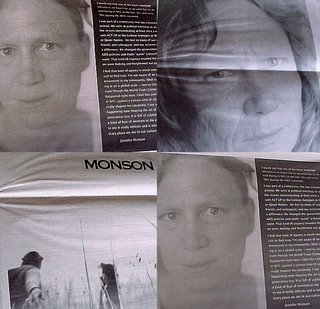
movement research performance journal #30 magazine merits a good read with its spotlight on 2006-2007 bessie award winner and dance maker jennifer monson. the incisive interview by movement research board of directors president ishmael houston-jones brings to the fore this energizing presence during/veteran of the high tide of queer and anti-interventionist activism during reagan and bush i. monson’s words in mrpj so resonate to the core:

“i would say that one of the most important influences on how i live as an artist has to do with being in nyc in the late ’80s and early ’90s during the aids epidemic.

“i was part of a community that was extremely activist. we were at political meetings or on the streets demonstrating at least once a week with act up or the lesbian avengers or wham [women’s health action mobilization] or queer nation. we lost so many of our colleagues; and our activism made a difference. we changed the government’s aids policies and made ‘queer’ a household word. that kind of urgency invaded the work we were making and heightened our passion.

“i feel that kind of agency is much more difficult to find now. i’m not aware of an anti-war movement in my community. what is happening is on a global scale—not so close to home even though the world trade center explosion happened right here. i feel like coming age in nyc against a certain kind of adversity has really shaped me creatively. i see what is happening now shaping the art of another generation too. it is full of subtlety and irony, a kind of fear of emotion or the personal. but to me it really reflects and is interpreting the scare place we are in our culture at present.”

houston-jones’ interview, along with accompanying articles by andrea liu, roselee goldberg, and abigail levine further delineate the contribution scope of mrpj 30’s cover artist and lover of improvisation, and offer a great timeline of and glimpse into the cultural cauldron of the eighties.

beyond being one of the world's leading laboratories for the investigation of dance and movement-based forms, movement research is a great finger on nyc’s cultural pulse. for more information, check out their website: www.movementresearch.org

Monday, November 20, 2006

kleindeutschland: exodus fueled by grief


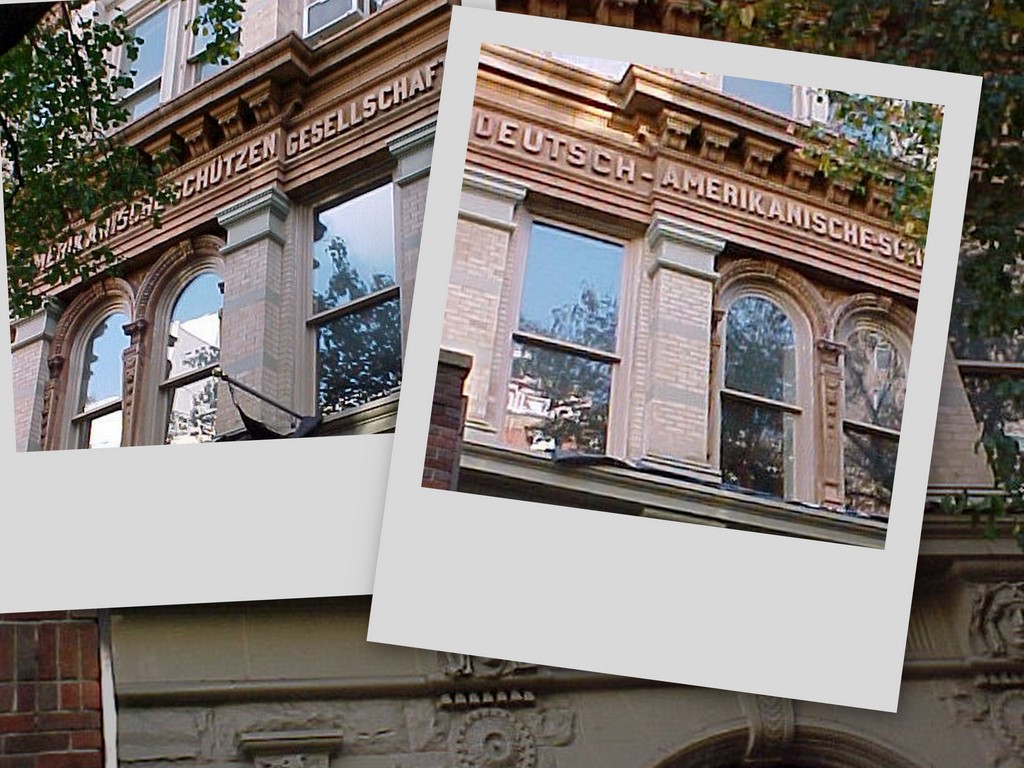
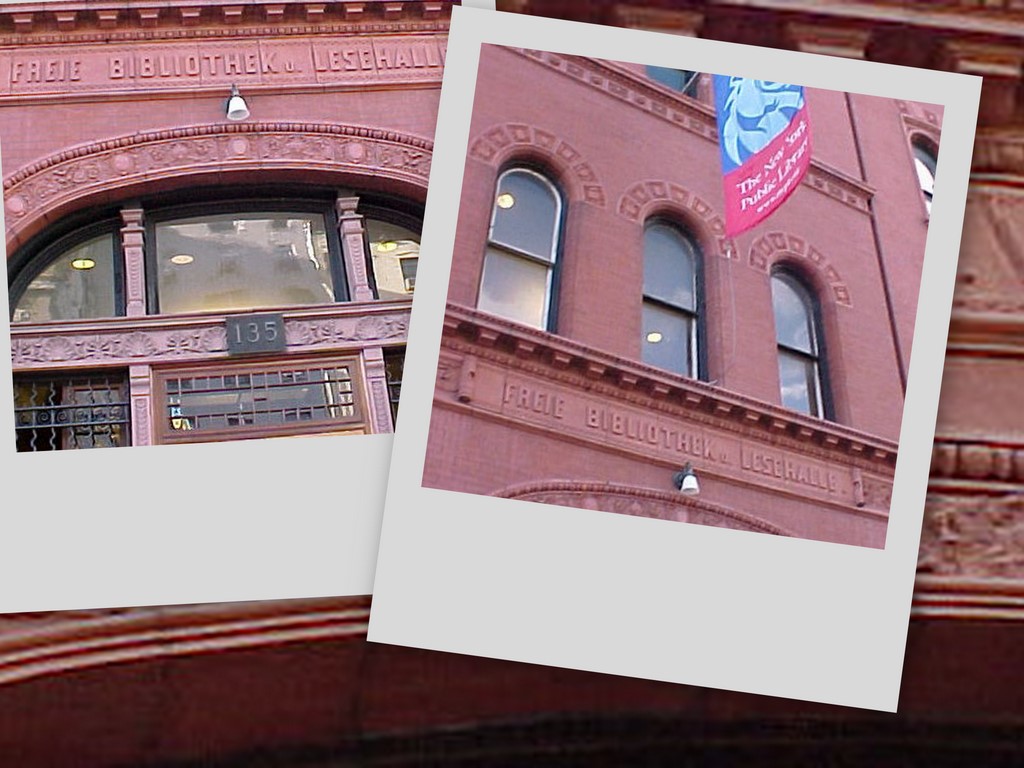
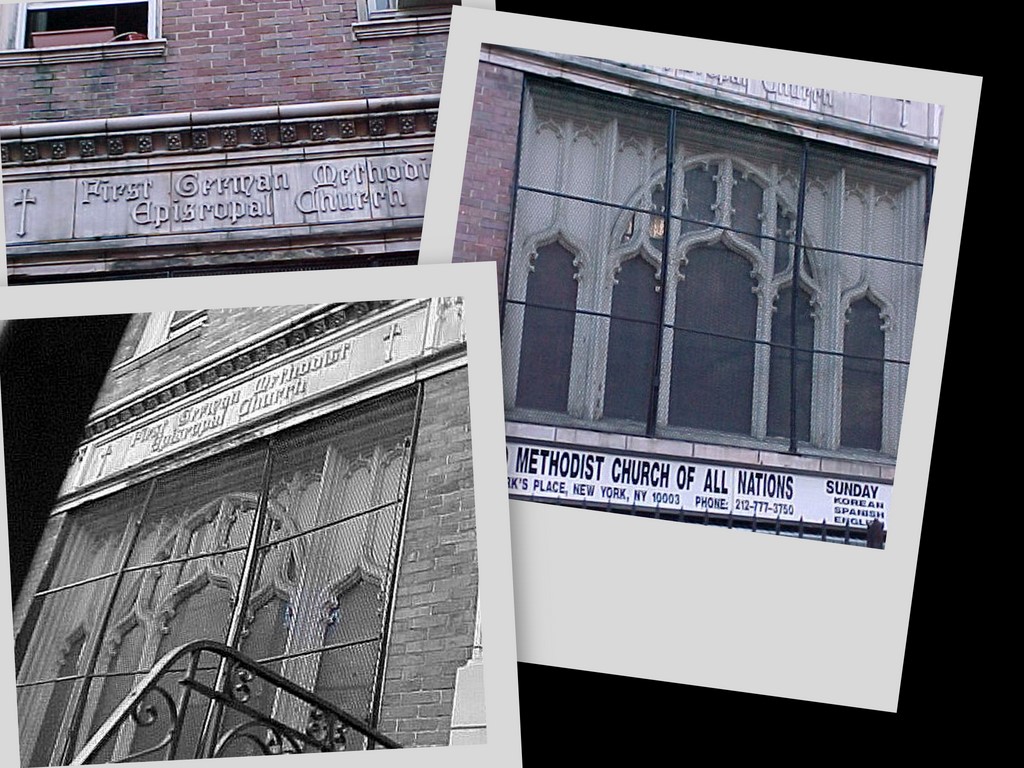
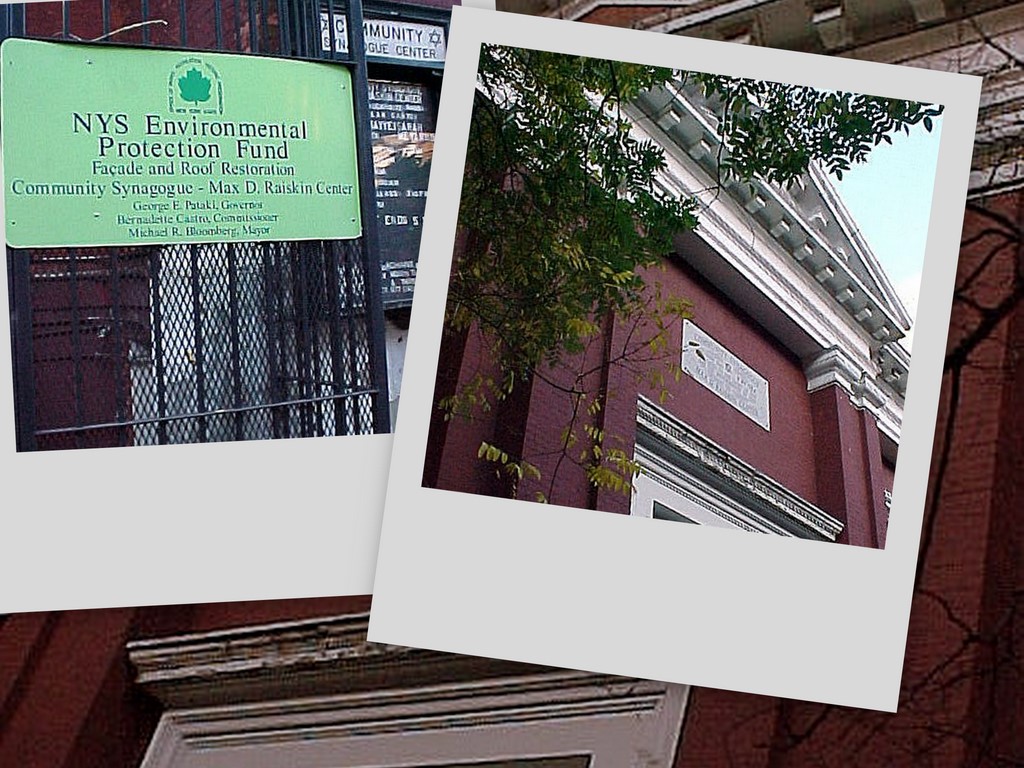
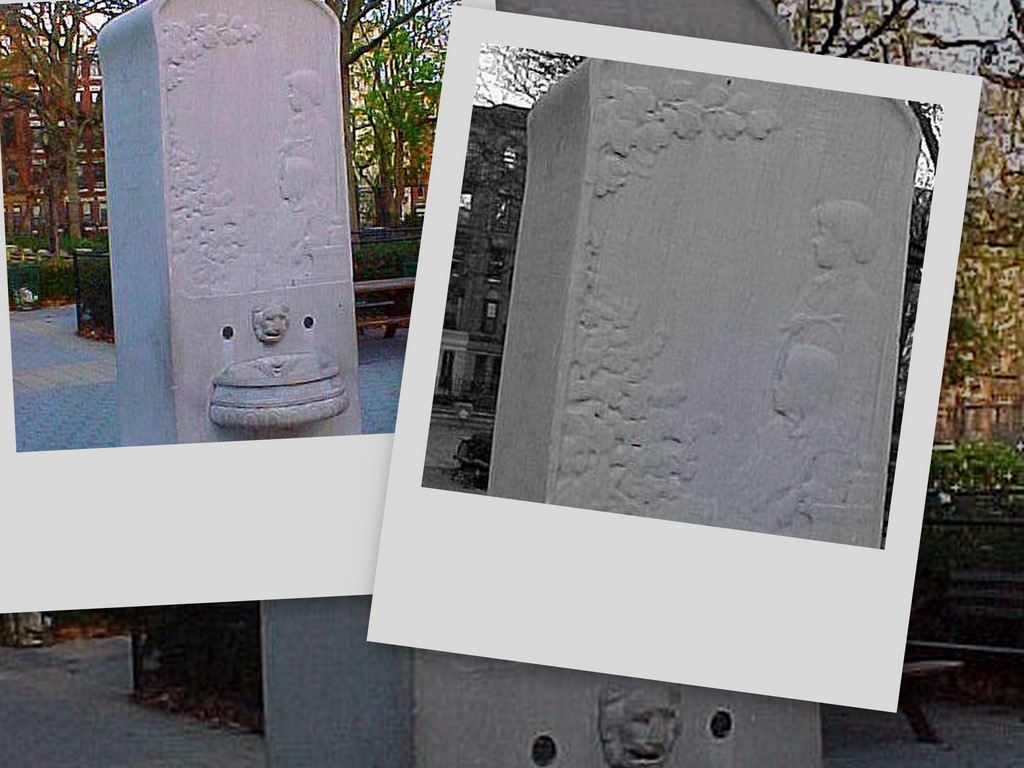
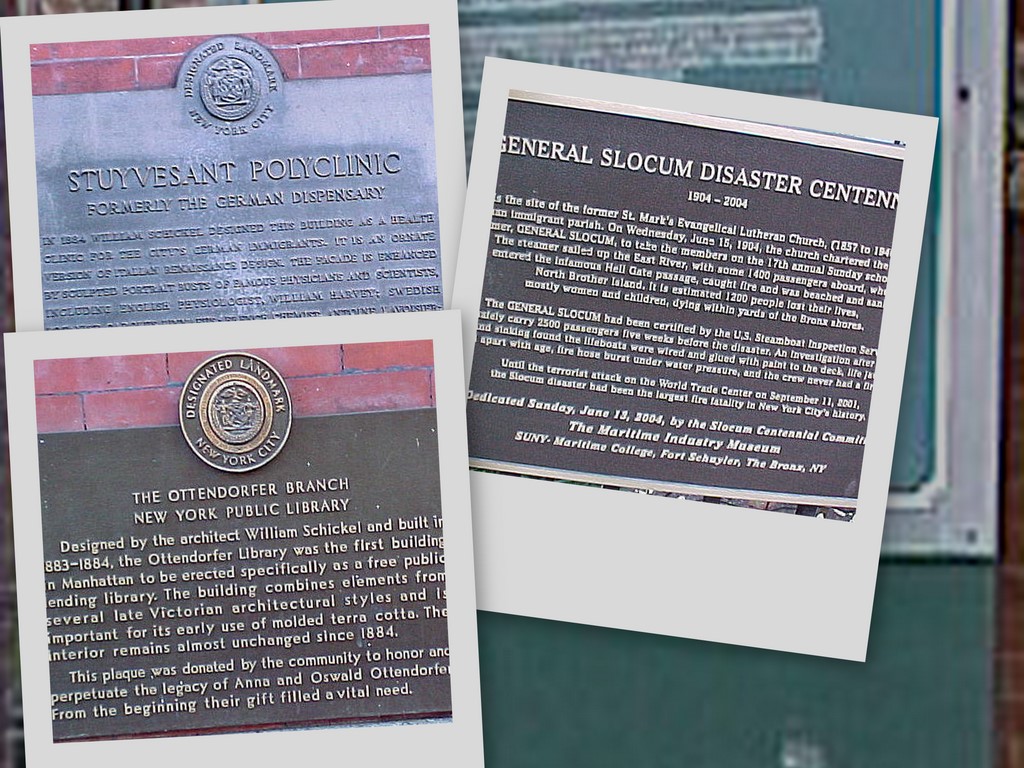
[former deutsch-amerikanishe-schützen gesellschaft @ 12 st. mark’s place, built in 1888—16 years before the tragedy ~ former freie bibliothek u. lesehalle @ 135 second avenue (now ottendorfer branch, new york public library) ~ former deutsches dispensary (later stuyvesant polyclinic) @ 137 second avenue ~ former 1st german methodist episcopal church @ 48 st. mark’s place ~ former st. mark’s evangelical lutheran church (now community synagogue) @ 6th street ~ monument in tompkins square park in remembrance of “the earth’s purest children—young and fair” dedicated by the sympathy society of german ladies (in “the year of our lord mcmvi”) ~ historical markers chronicling kleindeutschland]

kleindeutschland—in what is today’s east village—was the home to over 80,000 germans by the 1870s. (they had started arriving in large numbers during the 1840s.) on the morning of june 15, 1904, that community suffered an unspeakable tragedy.

prior to september 11, 2001, the burning of the general slocum had the highest death toll of any disaster in new york city’s history—catching fire in the east river with approximately 1,300 people on board, including many children. chartered by st. mark’s evangelical lutheran church on east 6th street for their 17th annual excursion to a picnic grounds on long island, the triple deck wood sided paddler burned in the course of 20 minutes on that morning. members of this church—along with their roman catholic and jewish friends and neighbors invited along for the outing—listened to a band play german favorites while adults talked and children romped. a spark—possibly from a carelessly tossed match—ignited a barrel of straw. smoke billowed upward after the excursion passed 90th street: by the time the general slocum passed randall’s island, massive flames began to consume the ship.

the majority of the ship’s lifejackets were worthless because the material then used—cork—had turned to dust over time. rather than keeping these people afloat in this period when fewer people learned to swim, the lifejackets actually absorbed water and pulled people under. the slocum’s six lifeboats were held to the ship by a thick coat of paint, while its fire hoses burst under pressure. the vessel burned to its waterline in 15 minutes. passengers jumped into hell’s gate—new york’s most turbulent waterway—rather than be consumed by the flames in the way their fellow new yorkers jumped from the world trade center nearly a century later.

consider the fact that the titanic went down in the atlantic with over 1,500 souls in the murkey waters of the north atlantic, 380 miles off newfoundland: the slocum consumed the lives of at least 1,021 within sight of horrified onlookers in manhattan, queens, and the bronx. as the tragedy transpired, the river was full of every kind of vessel.

from the residents who found hundreds of bodies washing up on astoria’s shoreline to crews of tugs, fireboats, a police boat, and more than a hundred other vessels that joined the rescue effort (some of which caught fire attempting to fetch passengers from the stricken ship) to sickened newspaper editors who received dispatches from their reporters, the events of that june morning reverberated all over the city. heartbroken crews on boats seeking to offer assistance found exponentially more lifeless bodies of passengers than survivors. [remember the doctors and staff at st. vincent’s hospital who lined up the morning of september 11th, waiting to assist scores of survivors that never came?] those assisting with rescue were unable to contain sobs as the bodies of the general slocum’s doomed passengers—most of them of young children—piled up.

although the population of kleindeutschland had begun to migrate to other areas of the metropolitan area—notably the uptown neighborhood of yorkville—the general slocum tragedy hastened the departure of grief-stricken neighbors and family members. apartments and shops had been left empty in a neighborhood swirling with panic and confusion. nearly everyone in the neighborhood—in which funerals and memorial services went on in shifts for days—had known someone on that ill-fated outing. dazed men who had come home that june 15 to find their wives and children consumed (and dozens had lost entire families), could no longer bear to return to empty apartments that reminded them of their loss. numerous suicides consumed inconsolable survivors. the german theatres, restaurants, fraternal societies, athletic clubs, bookshops, beer gardens, churches, and synagogues serving the immigrant german community and its offspring closed their doors and moved uptown. by the 1910 census, few of that traumatized german community remained.

vestiges remain. at the united methodist church of all nations, 48 st. mark’s, where once the nunc dimittis, collects, and invitatories were said in german, prayers now are heard in english, castellano, and korean. its inscription attests to its former parishioners. clinics and libraries built by those erstwhile new americans are now utilized—in another century—by new yorkers of many religions and national backgrounds. maritime laws promulgated in the wake of the general slocum tragedy now protect all americans.

Sunday, November 19, 2006

william blake’s “jerusalem”: revolutionary anthem

[digital composite: billy bragg, british suffragettes, blake book, blake drawing, blake portrait, text of “jerusalem,” & proms logo, 2006]

“jerusalem,” the song synthesizing william blake’s piercing lines with hubert parry’s scorching tune, has different meanings depending upon whom you ask. those who fought for women’s suffrage saw it as a call to arms… rugby fans and the “patriotic” set hear it as love of god and country. (king george v favored it over “god save the king” as the national anthem.) oh, and the labour party had their go at it too—it was used by the triumphant clement attlee campaign that wrested away power from winston churchill. (mr. attlee’s government may have done wonderful things like creating the national health service, but he also made that disgraceful, detestable, and insufferable anti-semite ernest bevin british foreign secretary.) today, it concludes the bbc proms summer concert program—along with edward elgar’s “pomp and circumstance march no. 1” (land of hope and glory), sir henry wood’s “fantasia on british sea songs,” and thomas arne’s “rule britannia.”

“jerusalem” brings back a blustery (yet sunny) sunday morning in buenos aires when i was lost only blocks away from the casa rosada: its strains the beacon guiding me to services at that city’s anglican cathedral in july 2001. from where else, but an anglican service, would that music be coming! to my amusement, i discovered they were singing “jerusalem” in castellano.

personally, i see “jerusalem” as a revolutionary anthem recalling the horrendous human wreckage and dislocation of the industrial revolution, accompanied as it was by environmental destruction—especially relevant in today’s globalization trauma, closing auto plants, and slave labor job encroachment upon employment with benefits and human dignity. (kinda makes me jealous of brits, who get so many more opportunities to sing it.)

And did those feet in ancient time
Walk upon England's mountains green?
And was the holy Lamb of God
On England's pleasant pastures seen?

And did the Countenance Divine
Shine forth upon our clouded hills?
And was Jerusalem builded here
Among these dark Satanic mills?

Bring me my bow of burning gold:
Bring me my arrows of desire:
Bring me my spear: O clouds unfold!
Bring me my chariot of fire.

I will not cease from mental fight,
Nor shall my sword sleep in my hand
Till we have built Jerusalem
In England's green and pleasant land.

billy bragg said it best in the liner notes of his 1990 cd “the internationale”:

“my belief that jerusalem is a left-wing anthem has got me into arguments with public schoolboys at eton and trotskyist newspaper sellers in trafalgar square. nevertheless, i remain convinced that this song does not belong alongside 'rule brittania' and 'land of hope and glory' at the last night of the proms. william blake was a radical and a visionary. a friend of thomas paine, [blake] was harassed by the establishment of his day, eventually being arrested for sedition. written at the time of the industrial revolution, i believe this song is an attack on the new breed of capitalists that blake saw in his midst. it asks how the morals of christ could possibly be compatible with the morality of exploitation of people and the environment.”

as an american, bragg’s comments are especially relevant in terms of blake’s relationship with thomas paine—the most revolutionary of our founding fathers and the true moral inspiration of the american revolution. paine is the radical whose incendiary writings and ideas may well be the most enduring mortar of our revolution. i remember having to memorize paine’s “american crisis” as a ninth grader: something done with little enthusiasm. reading paine’s words today, i realize that learning experience was wrecked by watergate then raging—on the heels of our vietnam experience and the coup in chile:

“these are the times that try men's souls. the summer soldier and the sunshine patriot will, in this crisis, shrink from the service of their country; but he that stands it now, deserves the love and thanks of man and woman. tyranny, like hell, is not easily conquered; yet we have this consolation with us, that the harder the conflict, the more glorious the triumph. what we obtain too cheap, we esteem too lightly: it is dearness only that gives every thing its value. heaven knows how to put a proper price upon its goods; and it would be strange indeed if so celestial an article as freedom should not be highly rated.”

one can only hope that paine will eventually have his parry… but then, do we really want to hear paine’s words sung by the super bowl's insipid?

Thursday, November 16, 2006

brian chippendale: sets


[brian chippendale, preemptive strike, 2006]

the mania of brian chippendale’s work—whether in his music, art, or prolific comics—is invigorating, though sometimes overwhelming. it’s like a banquet with several steaming and mouth-watering dishes: which does one try first? well, “sets”—a brian chippendale installation will only be at d’amelio terras until november 25, so you’ll have to quickly decide which angle to ingest. drummer or saxophonist, this hurricane out of providence, rhode island, has been associated with lightning bolt and black pus. in providence, chippendale participated in fort thunder, a workspace for avant-garde artists once ensconced in an antebellum textile factory.

“sets” is part of a troika exhibition of visual artists who traverse that milieu into music—those modes of expression influencing the other. (bjorn copeland and hisham akira bharoocha are the other two—both of whom also share strong roots in providence’s seminal creative scene.) the successive installations at d’amelio terras reference the structure and energy of sets at a musical event. the works of all three share an immediacy—with bright optical form and color—in which the visual and musical aspects magnify the other. [on saturday, december 16, catch the black pus performance at d’amelio terras (7-9 pm)].

a publisher of numerous zines and comics, chippendale’s ninja—a 144 page, 11 x 17 monster of a graphic novel/art book about ninjas, gentrification, sex, walking, and other things—has just been published by picturebox inc. chippendale’s first book, it’s been four years in the making and will be available at d’amelio terras during the exhibition.

nov 9-nov 25, 2006/ d’amelio terras/
525 west 22nd street/nyc 10011/t 212.352.9460/
f 212.352.9464/tuesday-saturday, 11 – 6 pm /
gallery@damelioterras.com
http://www.damelioterras.com

for information about chippendale’s book “ninjas”:
http://www.pictureboxinc.com/

Wednesday, November 15, 2006

¡la raza musical!


[digital composite: chris montez, vikki carr, cannibal & the headhunters, santana, 2006]

forty years ago marked the emergent confluence of rock-era latino musical acts that opened the door for the many acts that would follow… who could forget tejano vikki carr (florencia bisenta de casillas martinez cardona) whose hit “it must be him” made the top five in 1967? while her greatest singing success was in castellano, she placed three english-language songs in the top 40 in the late sixties. her 1966 tour of vietnam—not to mention dean martin calling her “the best girl singer in the business”—helped propel this proud mexican-american singer to the stellar heights she achieved.

after the tragic death of pioneer ritchie valens—who pushed the envelope both as a rocker and mexican-american in the music business—chris montez (christopher montanez) became one of the leading figures in rock-and-roll in the los angeles scene. montez broke through with his hard-edged international hit “let’s dance” in 1962. under the tutelage of herb alpert, he had a string of hits in the mid-1960s including “call me,” “the more i see you,” and “time after time.” montez went to high school with members of the beach boys and toured the uk with the nascent beatles.

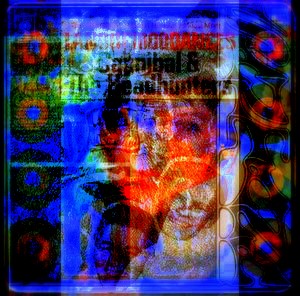
another mexican-american los angeles act also toured with the beatles (opening for the fab four on their second american tour). cannibal & the headhunters—originating in east l.a.—was founded by richard lopez in 1965. other band members were frankie garcia, joe jaramillo, and bobby jaramillo. the same year they hit big with “land of a thousand dances.”

the santana blues band was formed in 1966 when several musicians joined with mexican-born carlos santana. after a change of member line-up and band name (shortened to santana), the group hit big with the 1969 “santana” album that hit number four on the u.s. album charts. a single off that album, “evil ways” reached number nine on the billboard charts. the group reached its pinnacle in 1970 with the album “abraxas” that hit number one on the album charts and sold over four million copies. carlos’ brother jorge—a talented guitarist himself—started malo, the latin rock band noted for their top 20 hit “suavacito” in 1972.

without a doubt, the finances of blacklisted folkies and former weavers pete seeger and lee hays (who were verboten on network tv at the time) were buoyed significantly by royalties generated by trini lopez’s international hit (and seeger/hays composition) “if i had a hammer,” which hit number one in 25 countries. on that debut album lopez also included a version of “la bamba.” lopez’s worldwide popularity was fueled by his “latinized” versions of current hits such as “lemon tree,” “coming home cindy,” and “sally was a good old girl” in the mid-sixties. additionally, he had his own network tv program and starred in 1967’s “the dirty dozen.”

“96 tears,” by question mark & the mysterians hit number one on billboard’s charts in 1966. formed in flint, michigan, by rudy martinez, larry borjas, robert balderrama, and robert martinez, this group could be considered a precursor of punk rock. later frank and rudy rodriguez joined. this group of mexican-american rockers were mostly born in texas, but grew up in michigan.

as mark guerrero, richie unterberger, and xispas colectivo point out on their websites, the blendells and the premiers hit big during the peak of beatlemania in 1964 with their respective hits “la, la, la, la, la” and “farmer john”—further putting latino rockers in the spotlight.

arizonan linda ronstadt, whose father is mexican-american, was signed to capitol records with her group, the stone poneys in 1966. the group hit big with “different drum” (written by monkee michael nesmith) in 1967.

gloria estefan, ricky martin, christina aguilera, and others who have found success in the eighties and nineties, perhaps, owe a debt of gratitude to those earlier acts.

http://www.markguerrero.net/main.php
http://www.xispas.com/music/xpop/xpop.htm
http://www.richieunterberger.com/premiers.html

la chascona #2: yermiyahu ahron taub


[la chascona: the santiago, chile, home of
nobel-winning poet pablo neruda]


history fuels the poetry of yermiyahu ahron taub. in the process of interacting with history, taub explores the questions of human agency that preserve—and sometimes heighten—mystery, rather than having to build monumental structures to transparency. while taub poses that poetry does not require the arduous burden of proof of history, he believes it must have a sense of coherence—that a poem must manifest its own rhythms and language. explore the work of this conscientious poet, researcher, and translator whose compositions have appeared in numerous english and yiddish language literary publications. taub, an alumnus of temple and emory universities, also served as yiddish subtitles editor for “divan,” a documentary film by pearl gluck. published by wind river
press, his first book of poetry—the insatiable psalm—explores the troubled but enduring love between a devout mother and her increasingly less observant son. dig into the following samples of this persistent excavator’s quarry. perhaps, you will discover for yourself their inherent rewards:

http://www.paumanokreview.com/4.4/taub.html
http://english.chass.ncsu.edu/freeverse/Archives/Spring_2003/poems/Y_Taub.html
http://www.muse-apprentice-guild.com/summer_2003/mag_writers/yermiyahu_ahron_taub/home.html
http://www.windriverpress.com/authors/taub.html

Tuesday, November 14, 2006

dave anderson: rough beauty


["breeze," dave anderson, 2004, gelatin silver print, 20 x 16 inches, sheet]

hard scrabble existence eked out by most of the residents of vidor, texas, are worthy of our attention. “rough beauty,” dave anderson’s show at clampart conveys this conviction. at the same time, anderson’s photography emphatically leaves the crude edges of this difficult existence intact. vidor—not too far from janis joplin’s hometown of port arthur—is a poor rural town burdened and branded by its past, and reviled for its history of ku klux klan activities. (the bill simpson murder is one notorious case of resistance by its white residents to desegregation.) anderson’s work digs beneath this obdurate veneer to explore the character of those maintaining despite poverty and allied hardship in an economic dismalness reminiscent of the great depression.

born in michigan in 1970, anderson first worked on bill clinton’s triumphant (and media savvy) 1992 campaign before joining the white house press office. later he joined mtv’s “choose or lose,” a comprehensive on- and off-air political awareness campaign for young voters about upcoming campaigns. anderson toured the country in the “choose or lose” bus that ultimately logged more than 85,000 miles through 48 states in order to assist registration of young voters in conjunction with “rock the vote.” after working on al gore’s ill-fated campaign, anderson joined a startup film production company in new york. hungry to document obscure parts of america that had eluded him while traveling for mtv, anderson hit the road with his camera. what was his only rule? he would not drive on any road larger than two lanes. the resulting sensitive and atmospheric prints reflect the influence of his teachers keith carter and michael kenna.

organized in conjunction with the release of anderson’s monograph of the same title from dewi lewis publishing, his clampart show runs from november 16 to december 16, 2006. check out the work of this winner of the santa fe center for photography’s project composition in 2005 whom germany’s fotomagazin has called one of the “shooting stars of the american photo scene.”

clampart/nov 16-dec 16, 2006/521-531 West 25th Street/
ground floor/nyc 10001/646.230.0020/f646.230.8008/
www.clampart.com/tuesday-saturday, 11:00 am - 6:00 pm

rough beauty/dave anderson/hardback, 120 pages
with 90 duotone photographs/dewi lewis publishing/
united kingdom/http://www.dewilewispublishing.com/

Saturday, November 11, 2006

paint the capitol pink...


sustained applause must go to the voters of vermont for electing socialist bernie sanders to fill the seat vacated by retiring senator jim jeffords. bernie has represented vermont's at-large district in the house since 1991. a popular mayor of the people’s republic of burlington (because of his work at revitalizing that city), bernie has distinguished himself in the house with his support of universal health care, opposition to “unfettered” free trade, and—most notably—his votes against both resolutions authorizing the use of force against iraq in 1991 and 2002. while he will become the first socialist ever to serve in the senate, bernie was the first socialist to have served in the house since victor berger and meyer london were elected to serve earlier in the 20th century (the former in wisconsin's 5th congressional district and the latter in the lower east side). though much farther to the left, communist party sympathizer/"fellow traveler" vito marcantonio served in the house from 1935-1951, usually running on the american labor party ticket. socialist frank zeidler served three terms as mayor of milwaukee from 1948-1960—despite the mccarthy era (and the fact that joe mccarthy represented wisconsin in the senate). bernie will be well-poised in the senate to continue his fight to preserve our civil liberties.

check out the following websites:
http://bernie.house.gov/legislation.asp
http://bernie.org/
http://www.commondreams.org/views05/0728-22.htm

“give ’em hell, bernie!”

Friday, November 10, 2006

epitaphs on lower fifth...


[18 west 10th street and 18 west 11th street respectively]

a block away from each other in one of the tonier precincts of the village are two townhouses bearing the address “18”—coincidentally the number that represents life in jewish custom. both bear historical and literary significance, though that significance is radically different.

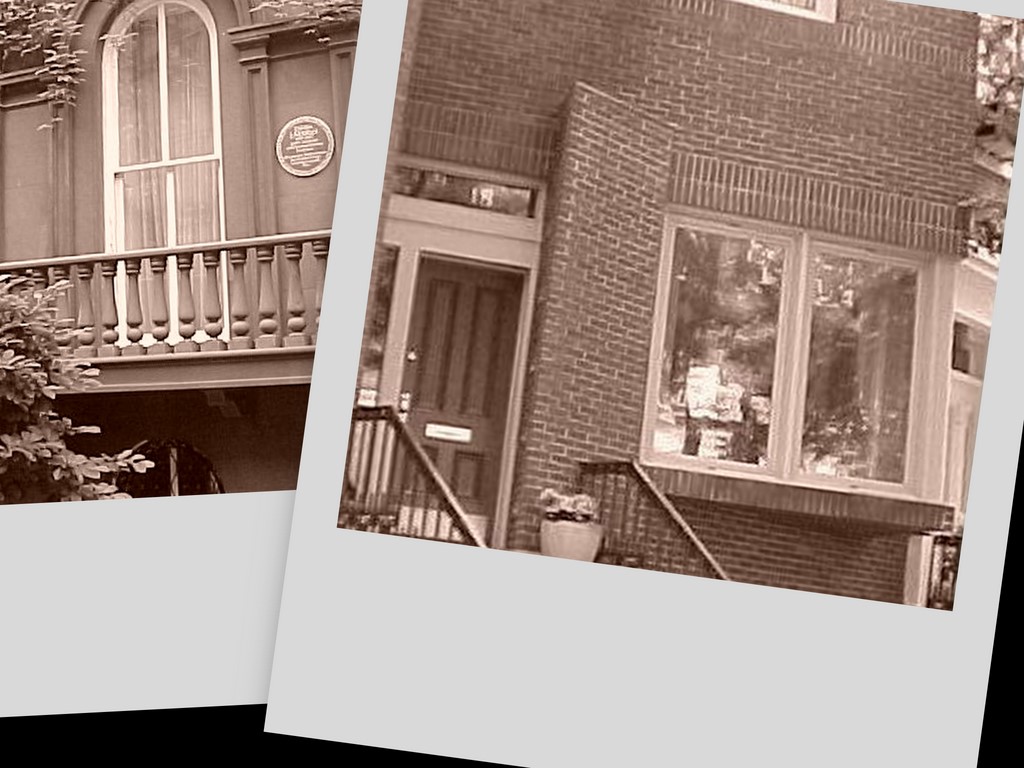
just before noon on march 6, 1970, 18 west 11th street—then owned by advertising executive james p. wilkerson—blew up when dynamite detonated in the basement bomb factory run by one of wilkerson's daughters, cathy; her friend cathy boudin; and three other bomb makers (diana oughton, ted gold, and terry robbins) who died in the explosion. then a weather underground "safe house," a bomb exploded accidentally while being prepared for an action. the fbi later reported that the group possessed sufficient amounts of explosive to level both sides of the street. protesting the war in vietnam, the group—according to new york times reporter mel gussow (who lived next door at the time)—had planned on destroying such sites as columbia university’s low library. (cathy wilkerson and kathy boudin escaped and remained fugitives for over a decade.) unlike its neighboring 19th-century red brick townhouses, no. 18 has a modern, angled front window. notably, the site of the explosion was the former residence of merrill lynch founder charles merrill and his son, the noted poet james merrill. james eventually recalled the tragedy in his poem “18 west 11th street,” part of which reads:

Seemed anger, the Aquarians in the basement
Had been perfecting a device
For making sense to us
If only briefly, and on pain Of incommunication ever after.

in the previous century, sugar refiner moses lazarus lived on the next block down at 18 west 10th street: there his daughter emma lazarus (1849-1887) wrote the poem “the new colossus” in 1883. this poem was later used for the inscription at the base of the statue of liberty—providing the famous lines: “give me your tired, your poor, your huddled masses yearning to breathe free, the wretched refuse of your teeming shore. send these, the homeless, tempest-tost to me, i lift my lamp beside the golden door!” a friend of ralph waldo emerson and a translator of german lyric poet heinrich heine, emma lazarus counted herself among american writers of that time who attempted to produce a literature independent of the british mold. growing up in a privileged sephardic family, she was moved by the travails of her less fortunate co-religionists who were then beginning to arrive in large numbers to escape grinding poverty and the terror of the pogroms. lazarus worked with the hebrew emigrant aid society

notably, she corresponded with writers and intellectuals such as emerson, william james, robert browning, and james russell lowell. her involvement in the literary world at the time was highly unusual on two accounts: on one hand by limitations normally placed on women at the time in any field, and on the other by her proud proclamations of jewish identity. thus, as an authentic american writer and a passionately outspoken jew, lazarus greatly pushed the envelope for women, jews, and america’s still self-conscious literature. ever ahead of her time, lazarus argued for the creation of a jewish homeland years before herzl was moved by the antics of anti-semitic vienna mayor karl lueger (and later, the outrage of the dreyfus affair) to foment zionism.

notes on the 2006 mid-term elections

who would have dreamed of such election results during the darkest hours after the 1994 electoral coup d’etat as both houses slid under gop control? i can never forget the shock—not to mention tears streaming down the faces—of chuck schumer, ruth messinger, david dinkins, and others at our “victory party.” how utterly depressing it was in the immediate days following in such “blue centers” as new york city.

what a relief to have been rid of santorum who has compared homosexuality to incest, bigamy and adultery, and supported un-intelligent “design” and privatization of social security. this is to say nothing of his role in the case of terry schiavo—irreversibly brain-damaged and beyond treatment. santorum needlessly involved himself in the painful decision of schiavo’s husband who sought to have her disconnected from a feeding tube—using such inflamatory language as "execution of the disabled." then, of course, there was santorum’s unsuccessful attempt to insert language into the every-child-left-behind bill in promotion of un-intelligent design—and questioning the academic standing of evolution in public schools! a steadfast member of the flat-earth society, santorum remains critical of 1965’s griswold vs. connecticut supreme court decision, which held that the u.s. constitution guaranteed right to privacy (within marriage), and on that basis, overturned a law that prohibited the sale and use of contraceptives.

new york: very interesting that one in five empire state republicans voted for hillary clinton, and one in three republicans voted for spitzer—allowing both to carry every region of the state: new york city, long island, upstate and the lower hudson valley. and to do so with nearly 70% of the vote! both also carried men and women and every race, age, income level and educational level. [2006 was the first election in many years in which democrats nationally won the majority—though slight—of male voters.] clinton managed to sidestep concerns of progressives in the party during the primary about her staking out centrist, if not conservative, positions on the issues (such as her support for making flag burning a crime)—that had led such bellwether democratic party organizations as village independent democrats, three parks independent democrats and gramercy stuyvesant independent democrats to endorse the anti-war campaign of labor organizer jonathan tasini.

california: how time changes things! when nancy pelosi ran in the special election to fill the seat of deceased rep. sala burton in 1987, i was appalled at her narrow victory over left-wing (and openly gay) san francisco supervisor and harvey milk protégé harry britt. who would have thought that she would become the most powerful woman in our nation’s history? as to her ability to work with members of congress having differing ideologies, i point to her work after tiananmen square. she consistently cobbled together a coalition made up of congressional leftists and social/christian right conservatives to oppose most-favored-nation trading status for china.

iowa: in replacing retiring democratic governor tom vilsack (iowa’s first democratic governor since harold hughes’ tenure in the late 1960s/early 1970s), democratic secretary of state chet culver did so with 55%-44%. culver, 40, is the son of former u.s. senator john culver (who was defeated in the 1980 reagan debacle that also cost us senators george mcgovern, birch bayh, and frank church). meanwhile vilsack is exploring a presidential run. in the mid-90s i attended a dinner at manhattan’s tavern on the green restaurant that encouraged former iowans and graduates of that state’s many fine colleges to return there to fill jobs opening up in several sectors. vilsack—not to mention representatives of chambers of commerce from several iowa cities—listened intently to concerns of university-educated gay men and lesbians about leaving areas with non-discrimination protections for a state such as iowa which had none (with the exception of iowa city)—regardless of the economic opportunities there. as one chamber of commerce rep empathized: “why should you leave places such as new york and california where you have legal protection?” vilsack took these concerns to heart and issued a non-discrimination executive order—and met with strenuous opposition from the iowa legislature for doing so!

massachusetts: not only have bay staters elected deval patrick their first black governor (and the second elected black governor of any state after virginia’s wilder), but they have finally broken the chain of g.o.p. governors: william weld, paul cellucci, jane swift, and mitt romney.

ohio: ted strickland, who easily defeated ken blackwell, will become that state’s first democratic governor since dick celeste left office in 1991. celeste, known for steadfast commitment to appointment of pro-choice judges, was one of the first governors to issue an executive order banning discrimination on the basis of sexual orientation in state hiring. (pennsylvania’s milton schaap was the first.)

michigan: what a difference from 2002 when michigan voters threw democrat jennifer granholm into the lion’s den—electing her to the governorship with her hands tied and both houses of the state legislature in the hands of republicans. targeted by detergent millionaire dick devos, who dumped $35 million into his campaign, granholm will begin her second term as governor with a state house controlled by the democrats (by six seats) for the first time in years (and a state senate with increased democratic influence).

two of michigan's six house democrats are in line to head powerful committees: john dingell of dearborn will probably chair the house energy and commerce committee (involved with auto-related concerns) while detroit’s amazing john conyers is poised to lead the house judiciary committee. sen. carl levin, an opponent of the iraq war, is in line to become chairman of the senate armed services committee.

the reelection of senator debbie stabenow—who unseated bigot and santorum clone spencer abraham (whom dubya later named secretary of energy)—is especially sweet for me as she was a lansing area state legislator while i was a student at michigan state. dubbed by conservatives as the “welfare queen,” she has always been such a conscientious public servant. while working on her m.s.w. from state, she served on the ingham county board of commissioners—part of the time with commissioner extraordinaire mark grebner. (under that board, ingham became one of the first counties in the country to pass a sexual orientation nondiscrimination ordinance.) republican david brandon lost his bid to keep his seat on the university of michigan board of regents while republican eileen weiser lost her bid to return to the state board of education.

alas, with the good also comes the bad. micromanaging michigan voters also passed the constitutionally questionable (and hopefully constitutionally unsustainable) ballot proposal that would ban use of affirmative action on the basis of race and sex in universities and governments.

rumsfeld: if nothing else, we can rejoice in the departure of defense secretary donald rumsfeld, who has served in that job longer than anyone except the notorious robert mcnamara, architect of our tragic policy in vietnam that squandered tens of thousands of american lives. michael ratner, president of the center for constitutional rights, is pursuing an international war crimes case against rumsfeld for the latter's authorization of torture at guantanamo. despite robert gates' role at the cia in connection to the iran-contra scandal and secret arming of saddam hussein, he is likely to be confirmed by democratic senators.

living in new york city, where one is subjected not only to new york political ads but to those of new jersey and connecticut as well, it will be a relief not to hear the horrible attack ads by kean against menendez. as to the mealy-mouthed joe lieberman, my hat goes off to ned lamont for ruffling the crypto-republican's feathers and holding him accountable.

Monday, November 06, 2006

solidarność/patco

it’s hard to believe that 25 years have passed since americans were confronted with the galling spectacle of ronald reagan’s crocodile tears on behalf of the polish workers and their independent trade union solidarity (solidarność)—while he vanquished an independent trade union in his own country (patco). on december 13, 1981, wojciech witold jaruzelski, first secretary of the polish united workers' party, imposed marshal law and outlawed solidarność. solidarność, founded in september 1980 at the lenin shipyards in gdansk (and led by lech wałęsa) provided the polish people an alternative and bulwark to the “communist” police state.

in 1981 the air traffic controllers in the united states went on strike, only to be nullified when reagan fired all 11,400 members of that union and permanently replaced them (while flight attendants, machinists, pilots, and other unions in that industry twiddled their thumbs). lane kirkland and the afl/cio machinery lamely excused their collaboration with reagan by citing patco’s endorsement of the republican in the 1980 presidential election. (horrendously, patco members were blacklisted for 12 years.)

who could keep a straight face when reagan orchestrated the january 1982 “let poland be poland” television propaganda program that vigorously promoted poland’s right to an independent trade union? (complete with frank sinatra singing 'ever homeward' in polish!) then there was reagan’s radio address to the american people (to explain suspension of most-favored-nation trading status with poland) that, to quote our then-president, called the outlawing of solidarność a “far-reaching step” in the polish communist government’s “persecution of their own people.” how dare they make their free union illegal,” he clucked. indeed! and how dare reagan fire thousands who refused to tolerate the dangerous situation then extant in our control towers—in a situation that common sense (not to mention passenger safety) dictated shorter shifts and fewer hours.

while reagan rightly cited the thuggish nature of poland's communist dictatorship, it was a little hard to take his platitudes seriously when he slavishly supported thuggish, murderous regimes elsewhere. to quote carlos fuentes: "let poland be poland—yes. but let el salvador be el salvador."

thus were the times 25 years ago!

Sunday, November 05, 2006

david wojnarowicz: a definitive history of five or six years on the lower east side


[interviews by sylvère lotringer, edited by giancarlo ambrosino. co-editors: chris kraus, hedi el kholti and justin cavin. afterword by jennifer doyle. october 2006, 220 pp., 70 illus, $24.95 (cloth)]

in february 1991, the artist david wojnarowicz (1954-1992) and the philosopher sylvère lotringer met in a borrowed east village apartment to conduct a long-awaited dialogue on wojnarowicz's work. lotringer held on to the tape for a long time. after wojnarowicz's death the following year, lotringer found the transcript enormously moving, yet somehow incomplete. david was trying, often with heartbreaking eloquence, to define not just his career but its position in time. the subject was huge, and transcended the actual dialogue. lotringer then spent the next several years gathering additional commentary on wojnarowicz's life and work from those who knew the warrior best—the friends with whom wojnarowicz collaborated. among those lotringer solicited personal testimony from included mike bildo, julia scher, richard kern, carlo mccormick, kiki smith, nan goldin, and marguerite van cook. at the time of the taping, wojnarowicz was at the peak of his notoriety as the antithesis of arch-reactionary senator jesse helms—a notoriety that wojnarowicz alternately embraced and rejected. already suffering the last stages of aids, wojnarowicz saw his dialogue with lotringer as a chance to set the record straight. the two arranged to have that three-hour dialogue video-recorded by a mutual friend, the artist marion scemama.

emerging from these interviews is a surprising insight into something art history knows, but systematically hides: the collaborative nature of the work of any "great artist." this is especially true in the case of an artist as "compelling" as wojnarowicz. all these respondents had, at one time, made performances, movies, sculptures, photographs, and other collaborative works with wojnarowicz. in that sense, wojnarowicz was not only a great originator, but a great synthesizer.

founded 30 years ago, semiotext(e) has proven itself the most influential of american independent presses. widely credited for having introduced french cultural theory to america, its backlist includes avant-garde fiction and non-fiction by american writers kathy acker, cookie mueller, eileen myles, and shulamith firestone. since 2000, the mit press has been the distributor of new titles published by semiotext(e). co-editor chris kraus is a filmmaker and the author of i love dick and aliens & anorexia, and co-editor of hatred of capitalism: a semiotext(e) reader. index called her "one of the most subversive voices in american fiction."

for further information: http://mitpress.mit.edu/catalog/browse/browse.asp?btype=8&pid=3

ellen kooi: recent photography


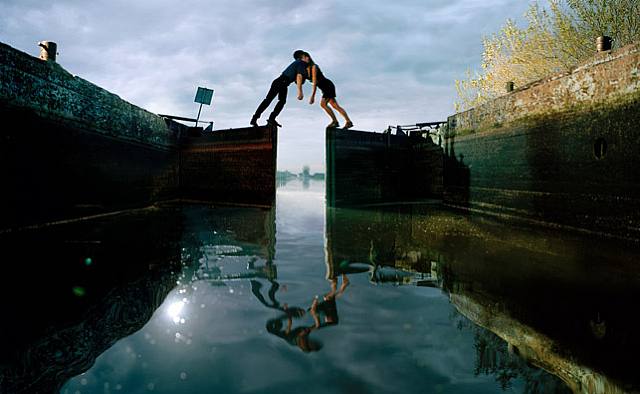
[nieuwkoop–sluis, 2004, enduraflex c-print on plexiglass, h: 39.5 x w: 64 in / h: 100.3 x w: 162.6 cm]

recent works by ellen kooi—whose photographs blend documentation and psychology of the dutch landscape—can be savored at her current show at p.p.o.w. in this, her second solo exhibition in the united states, kooi carefully stages her panoramas. kooi works in the manner of a film director—making preliminary sketches, designing the location and lighting, and positioning her human subjects. she does all this without sacrificing spontaneity in the course of an involved production method (including elaborate lighting and double and triple light exposures). not only do kooi’s subjects blend into the classical compositions they inhabit: they are fused with a documentary style and perfectly pitched technique. conflicting impulses that characterize life today are conveyed, while integrating rapid shifts in moods and conditions.

oct 20 - nov 25, 2006/p.p.o.w./ 555 West 25th Street, new york ny 10001/t 212.647.1044/f 212.647.1043/tuesday-saturday, 11 - 6 pm/http://www.ppowgallery.com/